
Rewilding the Seas: How Restoring Fish Stocks Drives Global Ocean Carbon Sequestration
SHARE VIA:
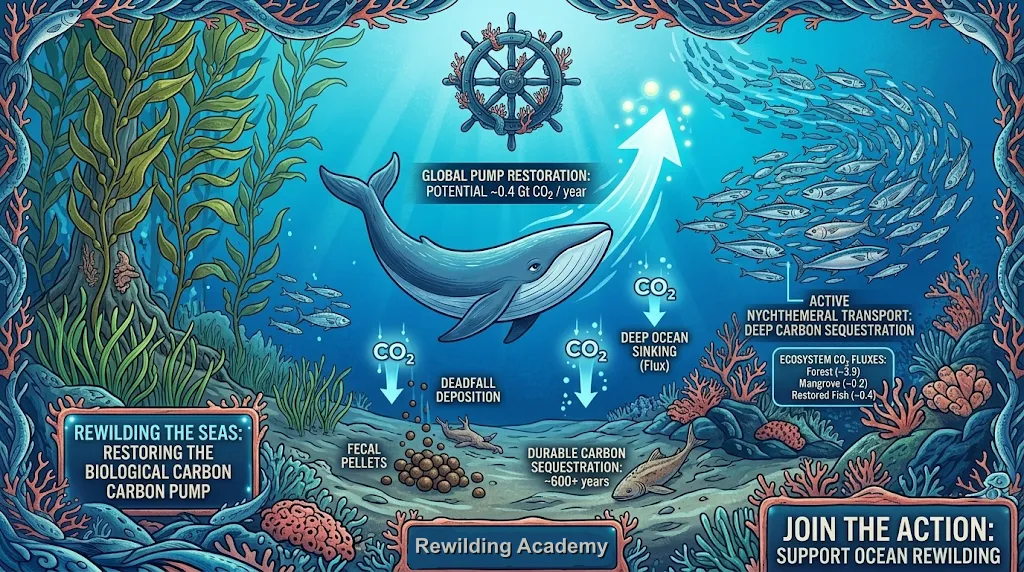
When discussions turn to nature-based climate solutions, terrestrial forests, peatlands, and coastal mangroves dominate global policy frameworks. Yet, beneath the ocean surface lies one of Earth’s most powerful, dynamic climate regulators: the Biological Carbon Pump. Driven not just by microscopic plankton but by diverse marine macrofauna – including predatory fish, deep-sea migrators, and marine mammals—this biological machinery moves gigatons of carbon from atmosphere-exposed surface waters directly into the deep ocean sediment.
Recent groundbreaking research, including landmark modeling by Gaël Mariani and colleagues (Nature Communications), reveals that industrial overfishing and climate warming are systematically dismantling this marine carbon pump. Far from being passive inhabitants of the sea, healthy fish populations act as active carbon engines. Restoring depleted commercial fish stocks represents an unprecedented, underutilized pathway for long-term carbon sequestration that rivals established coastal restoration strategies.
1. The Machinery of the Biological Carbon Pump
Marine fish directly facilitate carbon transport through several distinct, highly efficient ecological pathways:
- Fecal Pellet Export & Rapid Sinking: Unlike microscopic phytoplankton, large marine organisms produce dense, fast-sinking fecal pellets packed with organic carbon. These pellets sink hundreds of meters per day, escaping surface degradation before bacteria can convert the carbon back into atmospheric CO₂.
- Deadfall Carcass Deposition: When large pelagic fish—such as tuna, billfish, and sharks—die natural deaths, their carbon-rich bodies sink rapidly to the seafloor. This “carcass deadfall” buries organic carbon in deep-sea benthic environments where it remains isolated from the atmosphere for centuries.
- Diel Vertical Migration (Nychthemeral Transport): Billions of mesopelagic and deep-dwelling fish ascend to sunlit surface waters under the cover of darkness to feed on plankton, descending back into the twilight zone (200–1,000 meters) at dawn. By feeding at the surface and metabolizing waste at depth, they bypass upper ocean currents and actively inject carbon directly into deep storage layers.
- Nutrient Fertilization & Trophic Cascade Regulation: Marine fauna redistribute vital limiting nutrients like iron and nitrogen via excretion, fueling phytoplankton blooms. Simultaneously, top predators prevent overgrazing on blue carbon habitats like kelp forests and seagrass beds, preserving crucial coastal sinks.
Key Insight: Flux vs. Storage Durability
While terrestrial forests capture massive annual volumes of carbon (~3.9 GtC/yr), their storage durability is vulnerable to fires, land-use change, and disease (30–140 years). In contrast, marine carbon exported below 1,000 meters by fish macrofauna exhibits an extraordinary sequestration durability of ~600 years or more, offering long-term climate stability.
2. Quantifying Ecosystem Contributions
To evaluate the role of marine rewilding within carbon markets and climate frameworks, it is crucial to distinguish between annual flux (sequestration rate) and cumulative storage durability. The comparison below illustrates how marine macrofauna restoration compares with terrestrial and coastal blue carbon systems:
| Ecosystem / Mechanism | Typical Annual Sequestration Rate | Equivalent CO₂ Flux | Sequestration Durability |
| Terrestrial Forests | ~2.0 – 6.0 t C/ha/yr | ~7.3 – 22.0 t CO₂/ha/yr | 30 – 142 Years |
| Mangrove Restoration | ~1.74 – 4.5 t C/ha/yr | ~6.4 – 16.5 t CO₂/ha/yr | 20 – 770 Years |
| Fish Stock Restoration (Global) | ~0.03 – 0.08 Gt C/yr | ~0.15 – 0.30 Gt CO₂/yr | ~600+ Years |
(Note: 1 tonne of Carbon (C) = 3.667 tonnes of CO₂.)
On a global scale, restoring commercial marine macrofauna yields an annual carbon export benefit on par with global mangrove restoration (~0.15 – 0.30 Gt CO₂/yr), but with far greater durability against land-use disturbances.
3. The Cost of Industrial Overfishing & Climate Warming
For decades, ocean management treated fisheries solely through the lens of seafood yield. However, extracting millions of tons of fish biomass directly removes organic carbon from the sea, converting what would have been deep-sea carbon storage into greenhouse gas emissions during processing, transport, and consumption.
The findings published by Mariani et al. quantify the severe, compounding toll that overfishing and climate warming exert on marine carbon export:
- Sensitivity Ratio: Across marine ecosystems, a 1% loss in fish biomass leads to a 0.8% reduction in carbon export.
- Thermal Impacts: Ocean warming reduces macrofauna biomass by 4.2% and carbon export by 2.46% per 1°C of warming. Under high-emission scenarios (SSP 5–8.5), climate change alone will drive a 13.5% ± 6.6% decline in ocean carbon export by 2100 relative to the 1990s.
- Fisheries Amplification: Industrial fishing amplifies climate-driven reductions in carbon export by up to 56.7% ± 16.3%, generating a massive cumulative sequestration deficit of 14.6 ± 10.3 GtC (~53.5 Gt CO₂) by the year 2100.
4. Policy Action: Integrating Marine Rewilding into Climate Strategies
Restoring wild fish populations is not merely a biodiversity target – it is an actionable, scalable ocean-based climate solution. To reactivate the ocean’s natural carbon pump, global climate policies must embrace three strategic priorities:
- Protect High-Seas Carbon Hotspots: Establish fully protected Marine Protected Areas (MPAs) in key foraging grounds and vertical migration corridors to safeguard deep-water carbon transport from destructive bottom trawling and pelagic overfishing.
- Eliminate Harmful Fleet Subsidies: Shift government subsidies away from fuel-intensive, overcapacity industrial fishing fleets and redirect funding toward sustainable coastal management and ecosystem restoration.
- Include Marine Macrofauna in Blue Carbon Portfolios: Expand carbon accounting frameworks beyond coastal vegetation (mangroves, salt marshes, seagrass) to recognize the quantifiable carbon benefits of wild marine fauna recovery.
By protecting marine life and allowing fish stocks to recover to natural baseline densities, humanity can repair the planet’s greatest biological engine – locking away carbon for centuries to come.
Reference: Mariani, G., et al. (2025). Cumulative impacts of fisheries and climate change on marine macrofauna carbon export. Nature Communications.