Measuring the Yellowstone Trophic Cascade: A New Study Puts a Number on the Wolf Effect
SHARE VIA:
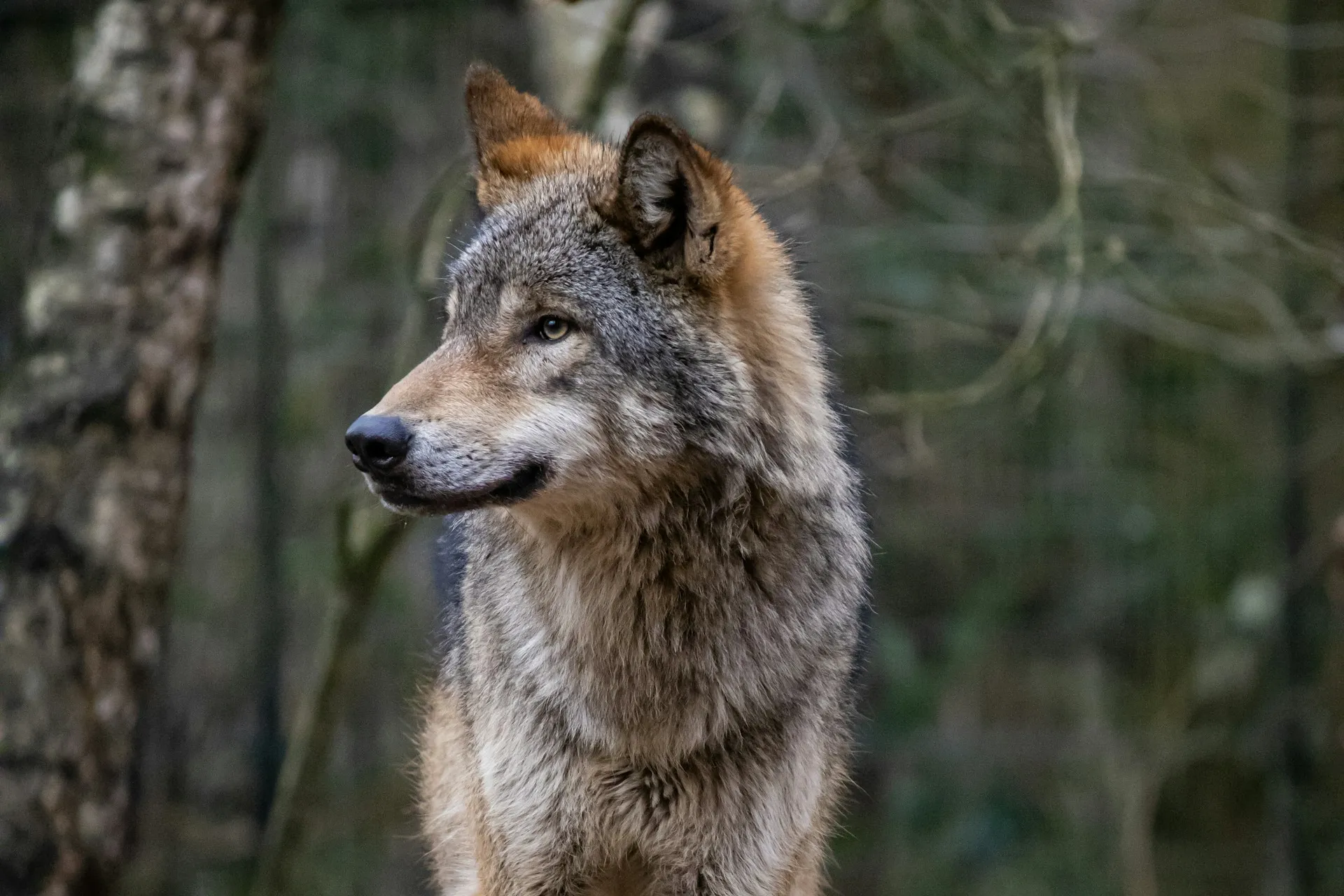
For thirty years, Yellowstone’s wolves have been rewilding’s most-told story: reintroduce an apex predator, and an entire ecosystem reorganizes itself around it. Elk stop lingering in the open, willows and aspens escape decades of overbrowsing, songbirds and beavers return to rebuilt riparian habitat. It is one of the field’s foundational case studies — but until recently, no one had put a precise number on just how strong that cascade actually was.
A study published in January 2025 in Global Ecology and Conservation, led by William Ripple and colleagues from Oregon State University and the University of Washington, set out to do exactly that. Rather than relying on willow height alone — the standard metric in most Yellowstone vegetation studies — the team used a newly developed model to convert twenty years of height measurements (2001–2020) into estimates of willow crown volume, a closer proxy for above-ground biomass. Crown volume, the researchers argue, better captures the total scale of a plant’s recovery than height does on its own.
The results, on their face, were striking. Average willow height in the park’s northern range roughly doubled over the study period, from 92 cm to 192 cm. Translated into crown volume, that increase amounted to roughly 1,500 percent — from about 0.3 cubic meters to 4.8 cubic meters per plant. Using the log10 response ratio, a standard metric ecologists use to compare cascade strength across ecosystems, the researchers calculated a ratio of 1.21, which they reported as exceeding 82 percent of the trophic cascades catalogued in a widely cited global meta-analysis. By that measure, the paper concluded, Yellowstone’s wolf-driven cascade ranks among the strongest ever documented — anywhere in the world, in any ecosystem type.
Ecological hysteresis
The authors were careful to frame the finding within a larger, more complicated story. Yellowstone’s northern range hasn’t simply snapped back to its pre-extirpation state. Decades of unchecked elk browsing didn’t just suppress willows — it also helped drive out beavers, whose dams once stabilized stream channels and water tables. Their long absence let streams cut down and dry out sections of floodplain, making it harder for willows to recover in places even after elk pressure eased. The authors call this ecological hysteresis: a system whose recovery path doesn’t simply retrace its path of decline. They also note their data come from a “natural experiment” rather than a controlled trial, and that cascades of this kind can take decades to fully express themselves — a case for sustained, long-term monitoring rather than snapshot conclusions.
Caution
That caution turned out to be warranted. In October 2025, ecologists Daniel MacNulty (Utah State University), David Cooper (Colorado State University), and colleagues published a formal peer-reviewed comment on the paper, in the same journal, arguing that its central claim doesn’t hold up. Their critique centers on the crown-volume model itself: because it was built using willow height to both calculate and predict volume, they argue the relationship is partly circular — a statistical artifact that can produce an impressive-looking trend even without a correspondingly large biological change. They also point to methodological issues with comparing unmatched plots across the twenty-year span, and question whether the equilibrium assumptions underlying cross-ecosystem cascade comparisons are appropriate for a landscape as slowly recovering, and non-equilibrium, as Yellowstone’s northern range. Notably, their re-analysis lines up with earlier work by Hobbs and colleagues (2024) — based on the same underlying dataset — which found only a modest, spatially patchy cascade rather than a dramatic, park-wide one.
Both research teams agree on the essentials: wolves are back, elk behavior and numbers have shifted, and willows in at least some parts of the park are growing taller and denser than they were in the 1990s. What remains genuinely contested is the magnitude of that effect, and whether it deserves to be called one of the strongest trophic cascades on the planet or a more localized, context-dependent recovery.
For rewilding practitioners and communicators, the exchange is a useful reminder in itself. Yellowstone’s wolves are the case study most people reach for when explaining what predator restoration can do — but the size of that effect turns out to be harder to pin down, and more scientifically contested, than the popular narrative suggests. Good rewilding advocacy doesn’t need to oversell its best example. The wolf-elk-willow story remains real; getting its scale right is still a work in progress.
Source: Ripple, W.J., Beschta, R.L., Wolf, C., Painter, L.E., Wirsing, A.J. (2025). The strength of the Yellowstone trophic cascade after wolf reintroduction. Global Ecology and Conservation, 58, e03428. https://doi.org/10.1016/j.gecco.2025.e03428
See also: MacNulty, D.R., Cooper, D., Procko, M., Clark-Wolf, T.J. (2025). Flawed analysis invalidates claim of a strong Yellowstone trophic cascade after wolf reintroduction: A comment on Ripple et al. (2025). Global Ecology and Conservation, 63, e03899. https://doi.org/10.1016/j.gecco.2025.e03899